


From cheering, chanting, and intense match moments, the World Cup impacts more than just football and hype.
Every four years, the FIFA World Cup becomes more than just a regular sporting event. It becomes a global economic engine.
The 2026 FIFA World Cup will run from June 11 to July 19, featuring an expanded format of 48 teams and 104 matches across the United States, Canada, and Mexico.
Beyond football (or soccer, depending on where you are in the world), the tournament is expected to become one of the largest global commercial events of the decade, driving billions in advertising, tourism, hospitality, and consumer spending.
Billions of viewers tune in to watch their favourite teams battle it out, brands spend heavily on advertising, tourism surges, and consumer spending rises across everything from sportswear to food and beverages.
While the fans focus on the action on the pitch, investors often watch a different scoreboard: the companies positioned to benefit from the world's biggest sporting event.
From Packed Stadiums to Global Markets
It’s no secret that the World Cup influences consumer behaviour, online engagement, travel trends, media attention, and even financial markets.
As countries rally behind their national teams, global brands ramp up campaigns, launch limited-edition products, and compete for visibility during one of the most-watched events in the world.
For the US stock markets, the tournament often creates increased attention around companies tied to sportswear, hospitality, travel, food and beverage, and entertainment.
Sportswear brands are usually among the first companies that investors and consumers think about.
So, which stocks are people looking at when it comes to the World Cup?
Think Nike (NKE), Adidas (ADS) as the dominant sportswear in the football landscape through sponsorships. Every major match becomes an opportunity for these brands to increase merchandise sales and strengthen global visibility.
Other important sectors include:
- Sportswear, equipment, jerseys, merchandise (e.g., Nike, Adidas, Puma)
- Streaming and broadcast platforms (e.g., META, GOOGL, AAPL)
- Food and beverage (e.g., Coca-Cola, Pepsi, McDonald’s, Wing Stop, Anheuser-Busch InBev)
- Travel, airlines, and hotels (e.g., Airbnb, Host Hotels, Delta Airlines)
- Advertising, e-commerce (e.g., Amazon, Meta, Fox Corporation, Disney)
- Fintech companies, Payments (e.g., Mastercard, PayPal, Visa)
Note: Whilst there are more US stocks associated with the World Cup, not all are listed. We believe a stock can garner investor and user interest during a big sporting event, like the World Cup, although how the stock performs doesn’t necessarily reflect on a single event.
Always do your own research (DYOR).
Prediction Markets and the Rise of Interactive Viewing
Prediction markets and online betting platforms have become increasingly popular during major sporting events, allowing users to participate in real-time outcomes surrounding matches, players, and tournament results.
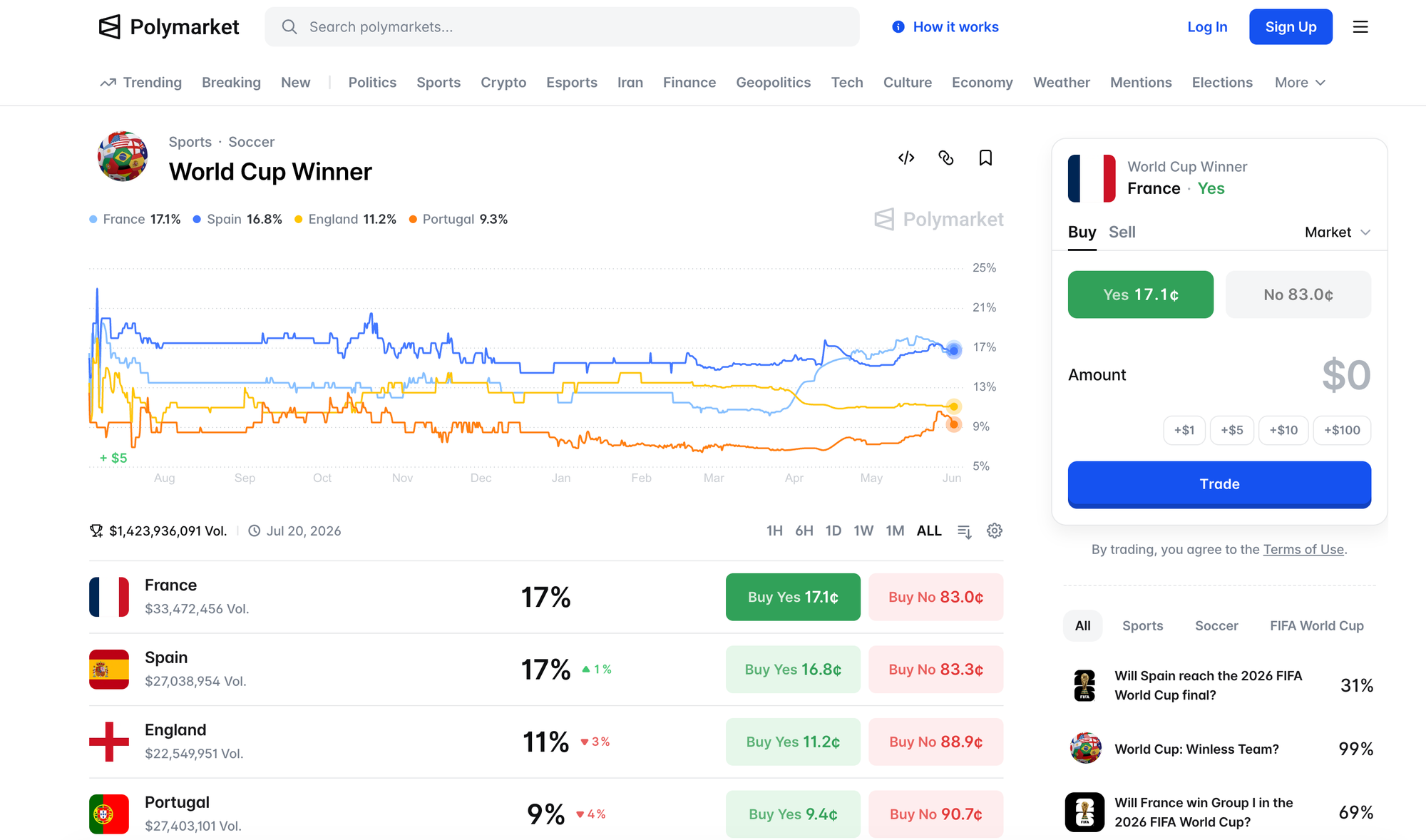
Platforms like Polymarket have already ramped up activity around sports-related markets, reflecting growing demand for interactive event-driven participation online.
This is where watching the game and being part of it is different. Every match creates new information. Every goal changes probabilities and outcomes.
You might be asking yourself:
- “Which token will follow the World Cup narrative?”
- “Will Brazil go to the semi-finals?”
- “Will a match go to penalties?”
- “Who will win the Golden Boot?”
- “Will there be extra time at the end of the match?”
All of these questions, and the most important one, who will be crowned the final champion, are becoming part of what crypto traders actively speculate on and trade around.
For many viewers and fans, the World Cup is no longer just about watching the matches in person or on TV. It is about participating in narratives, predictions, statistics, and real-time market reactions throughout the matches.
This broader shift highlights how global events are becoming increasingly financialised and interactive in the digital era, and are slowly moving more towards an onchain experience for all.
The Rise of Event-Driven Trading
So you might be wondering, “Why US stocks and the World Cup? How do they go hand-in-hand?”
Two great questions.
Major cultural events have always influenced markets, but access to these opportunities is changing.
The rise of tokenized stocks and real-world assets (RWAs) is helping bring global market exposure to a broader audience, allowing users to gain access to public equities directly through onchain platforms. Long gone are the days of betting at in-person brokers or gaining access to major US stocks through centralized platforms.
Event-driven trading is becoming more visible across both traditional finance and crypto-native ecosystems.
Adidas reported that early World Cup demand contributed approximately €250 million in World Cup-related bookings in Q1 2026, helping drive revenue growth of 14% year-over-year. The company expects similar demand in Q2 when the World Cup starts.
Goldman Sachs has also recently released which stocks they also see as winners in the World Cup 2026 tournament, citing that beer makers are set to make a gain, including athletic brand wear, being at the top of their list.
The World Cup may last only a few weeks, but the convergence of global events and onchain finance is a trend that is just getting started.
Our Final Thoughts
The bottom line is that the World Cup is seen as far bigger than it used to be.
We’re entering a digital era where US stocks are increasingly tied to major sporting narratives, while fans across the world participate in real-time predictions and trading.
From public equities to tokenized stocks and RWAs, users now have more ways than ever to gain exposure to the companies, sectors, and trends surrounding the world’s biggest sporting event.
The matches may only last 90 minutes, but the market conversations around them are what stick.
RWAs are coming to SynFutures. Stay up to date on X and be the first to trade.
About SynFutures
SynFutures is an onchain trading protocol for crypto and real-world assets, bringing stocks, ETFs, and derivatives onchain.
The V3 Oyster AMM launched the industry’s first-ever unified AMM and Permissionless Onchain Orderbook. Backed by top investors like Pantera, Polychain, Standard Crypto, Hashkey, and more, SynFutures has processed more than $100 billion in trading volume since its launch in 2021.
Learn more: